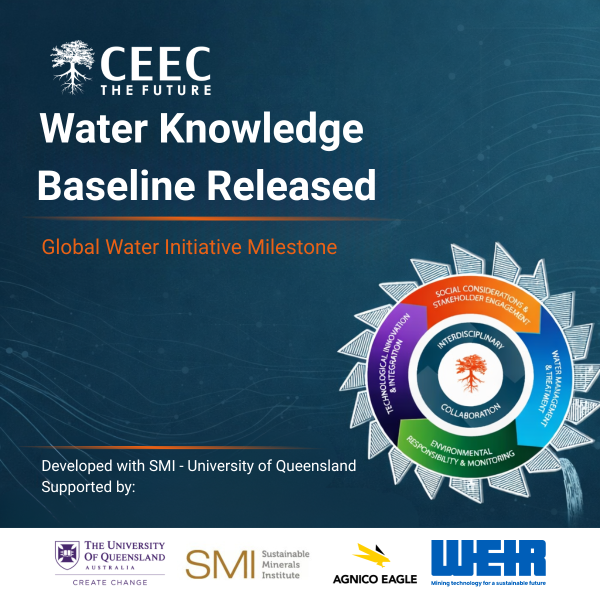
Establishng the Water Knowledge Baseline
CEEC International is pleased to announce the publication of the first edition of its Water Knowledge Baseline, a major milestone under the Global Water Initiative (GWI) that establishes a foundational reference to support improved water stewardship across the global minerals sector.
Developed in collaboration with The University of Queensland’s Sustainable Minerals Institute (SMI) and coordinated by Professor Claire Côte, with contributions from Professor Neil McIntyre, Professor Mansour Edraki, Dr Pascal Bolz, Dr Nevenka Bulovic, Dr Robynne Chrystal, Dr Louisa Rochford and Dr Mandana Shaygan, this report brings together essential concepts, frameworks, and technical context to help professionals better understand the complex water-related challenges associated with mining and mineral processing.
The Water Knowledge Baseline has been designed as a structured introductory resource covering key themes such as regulatory frameworks, hydrology, hydrogeology, water quality and treatment, monitoring, operational risks, and stakeholder considerations. It is intended to support engineers, sustainability practitioners, regulators, researchers, and project leaders by providing a coherent starting point for navigating water management topics and identifying pathways to more detailed technical guidance.
Professor Claire Cote of the Sustainable Minerals Institute said, “Water is one of the most complex and interconnected challenges facing the minerals sector today. Developing this Knowledge Baseline was about creating a practical, structured starting point that helps bridge disciplines, regions, and perspectives. By bringing together technical foundations and real-world context, we hope it empowers practitioners to make more informed decisions and supports stronger collaboration across industry, research, and government.”
Rather than serving as a prescriptive manual, the document functions as a practical orientation tool that promotes a shared language, strengthens multidisciplinary collaboration, and helps identify water-related risks and opportunities early in project lifecycles.
The release responds to a growing need across the sector for accessible, consolidated knowledge. While mining represents a relatively small share of global water consumption, it can account for a significant proportion of water use in regions where operations occur, sometimes contributing to competition among users such as agriculture, communities, and other industries.
At the same time, water risks - including supply uncertainty, flooding, infrastructure stability, and water quality impacts - are becoming more complex and site-specific, requiring integrated and informed decision-making.
Importantly, this first edition is intentionally positioned as a starting point rather than a final authority. The report outlines areas where progress is still required and identifies opportunities for improvement, recognising that much of the expertise needed to manage mine water risks currently resides within specialised practitioners and is not widely accessible in the public domain.
As such, the Water Knowledge Baseline is described as a working resource that will evolve through ongoing collaboration, feedback, and periodic updates.
Heather Ednie, Executive President of CEEC International, added, “This release marks an important step forward for CEEC’s Global Water Initiative and for the sector more broadly. The Water Knowledge Baseline is not intended to be the final word - it’s the beginning of a shared platform for learning, collaboration, and progress. We see this as a living resource that will grow through contributions from across the global mining community, helping to close knowledge gaps and accelerate practical solutions for responsible water stewardship.”
CEEC International extends its sincere thanks to the Sustainable Minerals Institute at The University of Queensland for their research leadership and commitment in developing this foundational report, as well as to Global Water Initiative sponsors Agnico Eagle and Weir for their valued support in enabling this work. Their collaboration reflects the shared industry commitment required to advance practical solutions and strengthen knowledge exchange on water stewardship.
Looking ahead, CEEC plans to expand the Baseline into a dynamic, interactive knowledge platform that enables industry professionals, researchers, and partners to contribute insights and expertise, creating a living resource that bridges academic and operational knowledge and supports continuous improvement across the sector.
CEEC International invites stakeholders across industry, academia, government, and the broader mining community to engage with the report and help shape its next phase. Feedback, technical input, references, and case studies are welcomed to strengthen the resource and address identified gaps. Those interested in contributing to Phase Two or participating in future development of the Water Knowledge Baseline are encouraged to contact CEEC International to get involved.