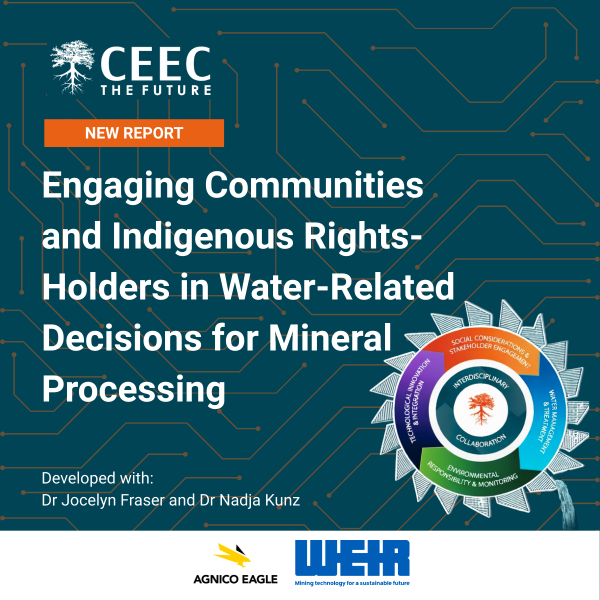
CEEC International has published a new report, exploring how communities and Indigenous rights-holders engage with mining and mineral processing companies on decisions related to water and tailings management, highlighting both the need for stronger collaboration and the opportunity for the sector to rethink how technical decisions are made. The research, authored by Dr Jocelyn Fraser and Dr Nadja Kunz as part of CEEC’s Global Water Initiative, examines barriers to meaningful engagement and identifies practical approaches that can help bridge the gap between engineering design processes and community priorities.
Water is emerging as one of the most significant risks facing the global mining sector, with water-related issues linked to 58 percent of complaints about mining projects investigated by the IFC’s Compliance Advisor Ombudsman.
This statistic reinforces why early engagement matters: most of a project’s long-term environmental and economic impacts are determined during early planning and design, when flexibility is highest, but community input is often lowest.
Drawing on interviews with experienced community representatives, Indigenous experts, and industry practitioners, the report finds that trust remains one of the most critical factors influencing whether engagement is effective. Low trust between companies and communities is widely recognised as a global challenge, and respondents emphasised that building strong relationships requires transparency, time, and genuine willingness to listen.
Context also matters: each community has distinct priorities, histories, and experiences with resource development that shape how new projects are perceived and how engagement should be approached.
The research highlights that while engagement practices are evolving, many companies still approach consultation primarily as a regulatory requirement rather than as a collaborative design input.
Community participation in technical decision-making - especially around water and tailings systems - remains relatively uncommon despite widespread recognition that early input can improve project outcomes and reduce risk.
Respondents stressed that engineers and technical professionals could play a more active role in this process, particularly when they communicate complex trade-offs in ways that are accessible to non-technical stakeholders and incorporate traditional knowledge alongside scientific data.
Dr Jocelyn Fraser said the findings demonstrate a clear need to rethink traditional approaches to project design and engagement. “What we heard consistently is that communities want to be part of the conversation earlier, when decisions can still be shaped,” she said. “When companies take time to understand local context, share information openly, and genuinely listen, they not only build trust but also make better technical and environmental decisions. The opportunity now is to move from consultation toward collaboration and co-design.”
The report filters expert insights into practical guidance for companies seeking to strengthen engagement, including prioritising water stewardship, investing in relationship-building before negotiations begin, preparing structured engagement strategies, and clearly communicating design trade-offs. It also emphasises that effective engagement should be treated as a core business priority supported by leadership, resources, and cross-functional teams rather than a standalone activity.
Heather Ednie, Executive President of CEEC International, said the report reinforces the organisation’s commitment to advancing responsible innovation through collaboration. “This work highlights that technical excellence and social understanding must go hand in hand,” she said. “Engineers and project teams have a powerful role to play in shaping solutions that respect community priorities while delivering operational performance. By strengthening those connections early, the industry can unlock better outcomes for projects, communities, and the environment.”
The initial phase of the research focused on Canada as a case study, but the findings point to strong potential for global expansion. Future phases may include additional interviews and comparative analysis across regions such as Australia and Chile to explore how regulatory frameworks, cultural contexts, and community expectations influence engagement practices.
The authors note that CEEC is well positioned to help address an industry-wide gap by supporting engineers and technical teams to integrate community perspectives into design decisions through training, resources, and collaborative platforms.
CEEC is inviting industry professionals, researchers, community representatives, and stakeholders interested in advancing responsible water and tailings decision-making to contribute to the next phase of this work. Those interested in providing feedback, sharing regional perspectives, participating in interviews, or collaborating on future research are encouraged to contact CEEC to express interest.